
Production stopped
The logic boards had failed and were beyond repair.
The logic boards had failed and were beyond repair.
The rebuild focused on the line controls.
The legacy architecture was replaced with WAGO / CODESYS controls.
The line was brought back into operation in stages with the rebuilt controls.
The platform is ready for future traceability and production-data developments. Cycle-time and availability gains still need to be measured over representative operating periods.
The mechanical base was retained while the control system was rebuilt. The decision links the value of the equipment to the risks of keeping an architecture that is difficult to support.
Compare the mechanical condition, lead time, downtime and total cost of a targeted retrofit with the alternatives.
Identify what blocks production, agree priorities and sequence the changes with the people operating the line.
Use identifiable signals, explicit machine states and event records to investigate the cause of a stop.
The original solution combined DOS software with proprietary logic and I/O boards. The logic boards had failed beyond repair, leaving the client unable to produce. The work involved reconstructing operating rules, coordinating movements and making stops understandable. The client had commissioned an earlier audit; OMNIATEC supplemented that initial understanding with on-site observations, interface checks and trials.
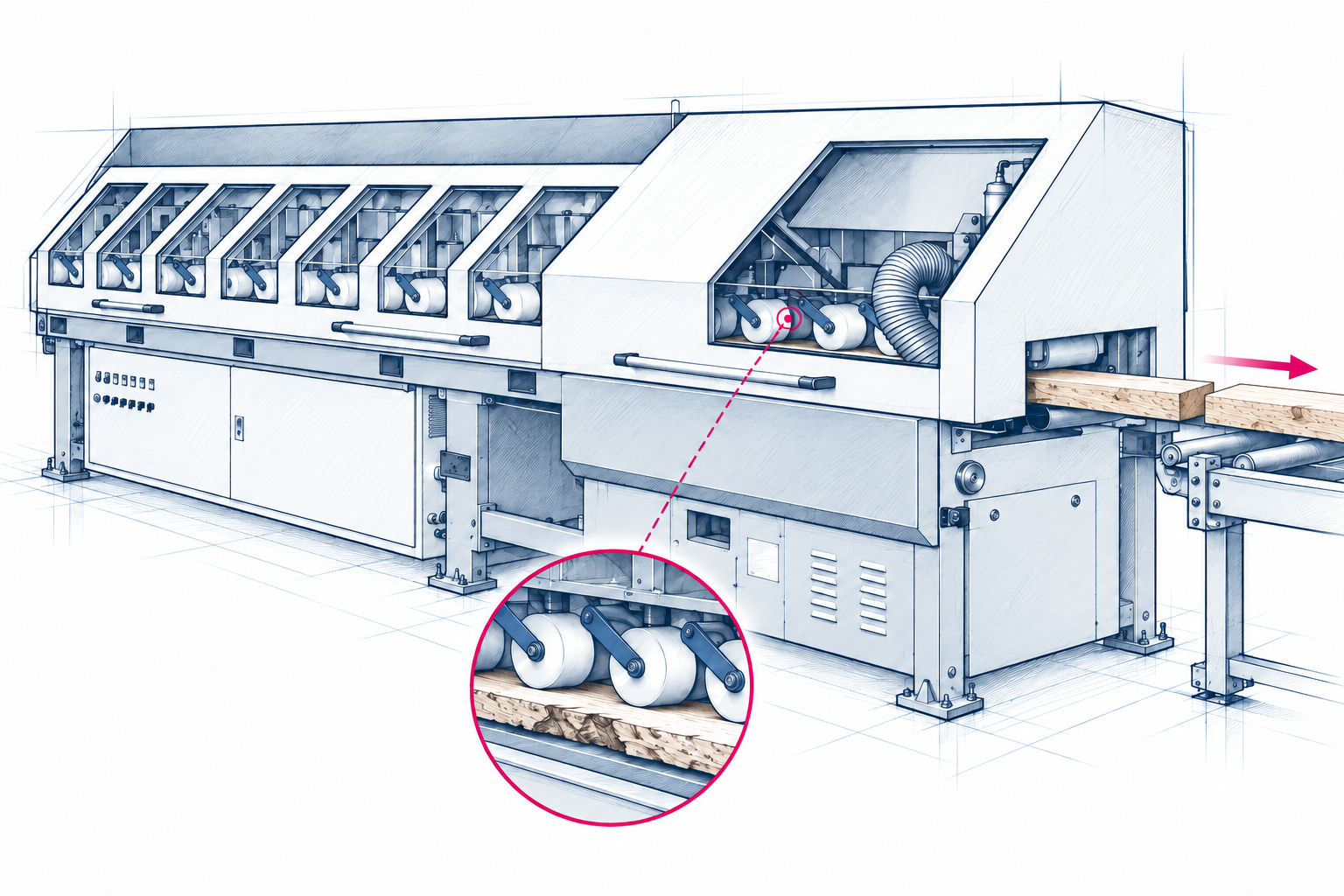
Board lengths, geometry and defects vary. A board can rub, jam or split at a crack. One expected offcut can become several fragments, passing sensors separately or only partially.
The challenge is to turn that variability into reliable control decisions. Physical observations must be matched to recorded signals to distinguish a mechanical blockage, an unexpected detection and a control inconsistency.
On the shop floor, a stop is a fact to explain. The correction comes afterwards.
The WAGO PFC200 G2 was selected because it was immediately available when equipment was ordered. Its computing resources shaped the software architecture. Some solutions had to be reworked because they were too demanding. The requirement was a program that remained efficient to execute, understandable and maintainable.
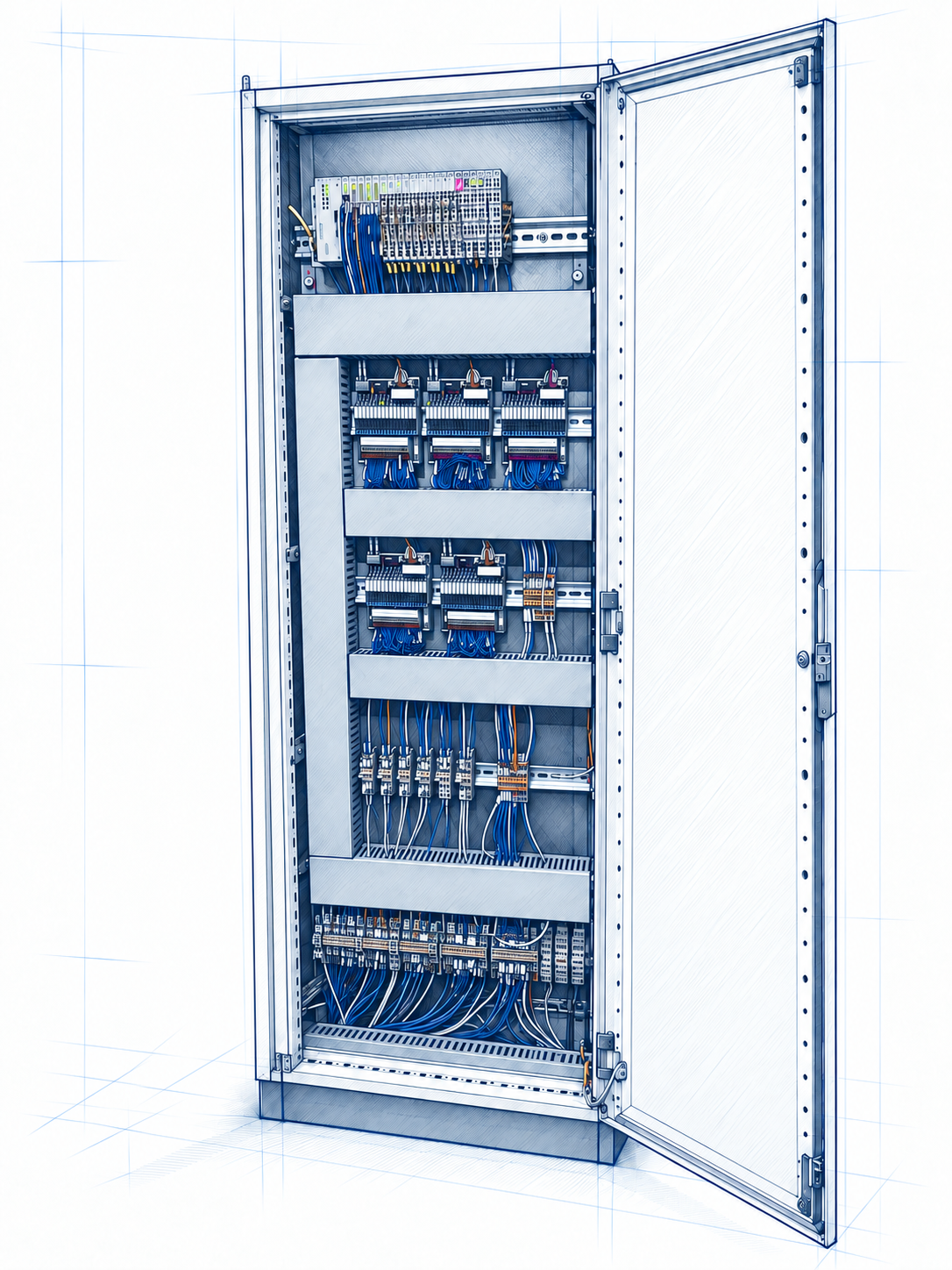
The project drew on electrical engineering and cabinet construction by Alsace STI, WAGO control technology and components supplied by Electro-Rhin.
An electrical cabinet built in a particularly short lead time.
Alsace STI produced the electrical drawings and cabinet in response to the urgency of the project. Its fast response helped move the controls rebuild forward.
The WAGO PFC200 G2 and I/O modules form the hardware core of the rebuilt control system.
Electro-Rhin supplied electrical, signalling and control components for the rebuild.
Computational work varies with board length, defects and cutting options. Decisions must adapt to the material while the work performed by each processing step remains bounded. Machine movements and relevant measurements take priority; data handling and display updates are organised separately.
Zone sequences, coordination, consistency checks and control decisions.
Deferred processing, data management and use of diagnostic records.
Machine states and operating information, with display work separated from control.
Movement alone is not enough. The measured material, cutting plan, actual position and destination of each piece must remain consistent.
Requested lengths, defects, grades, saw kerf and board ends constrain usable products, co-products and waste.
Use encoder feedback, manage the approach and verify the stop before clamping and sawing.
Coordinate cutting with sorter availability, track pieces between zones and allow the spacing required by the ejectors.
Record the first cause of a stop and its context, identify missing conditions and define restart rules. A fault acknowledgement alone must not restart a movement.
Diagnostics and changes continued during degraded operation, with workshop noise, variable timber, mechanical disturbances, false positives and operator resets. Each stop required the useful facts to be recovered before another attempt obscured them. Operating practices also had to change: restart conditions, fault handling and workarounds inherited from the previous equipment were reviewed with operators.
Use the earlier audit and available documentation, check I/O references and identify unknowns.
Define states, transitions and permissions between measurement, sawing and sorting.
Separate physical signals, machine states, settings, operator commands and alarms.
Use targeted scenarios and regression checks; identify versions before machine trials.
Check measurement, board ends, stops and restarts. Assess safety functions affected by the modification separately.
Document cutting rules, settings and operator actions. Preserve versions and explain machine behaviour.
OMNIATEC connects the mechanical, electrical, controls and process aspects of the problem. The approach is to establish what is known, prioritise production-critical functions and proceed through verifiable changes. Documentation and handover develop alongside the solution, so the result can be understood and maintained by the teams.
Reconstruct the actual machine behaviour, interfaces and operating constraints.
Separate immediate obstacles from improvements that can be addressed later.
Check critical functions before moving on, with changes and versions identified.
Make operating rules, diagnostics, parameters and responsibilities explicit.
Tell us about the machine, symptoms, available documents and production constraints. OMNIATEC helps determine whether to repair, improve reliability, modernise or rebuild.
Based in Scherwiller, near Sélestat in Alsace, OMNIATEC works at industrial sites in Alsace and Baden-Württemberg. Travel is arranged to suit each assignment, including sites around Strasbourg, Colmar, Mulhouse, Freiburg, Offenburg, Karlsruhe and Stuttgart. Working languages: French, German and English.
Tell us where the site is, which equipment or operation is involved and what is holding production back. The first discussion establishes the need; on-site diagnostics and engineering studies are quoted separately.
Discuss your requirements